How TOMS identified 16% margin recovery on cart abandonment flows with Relvino's agents.
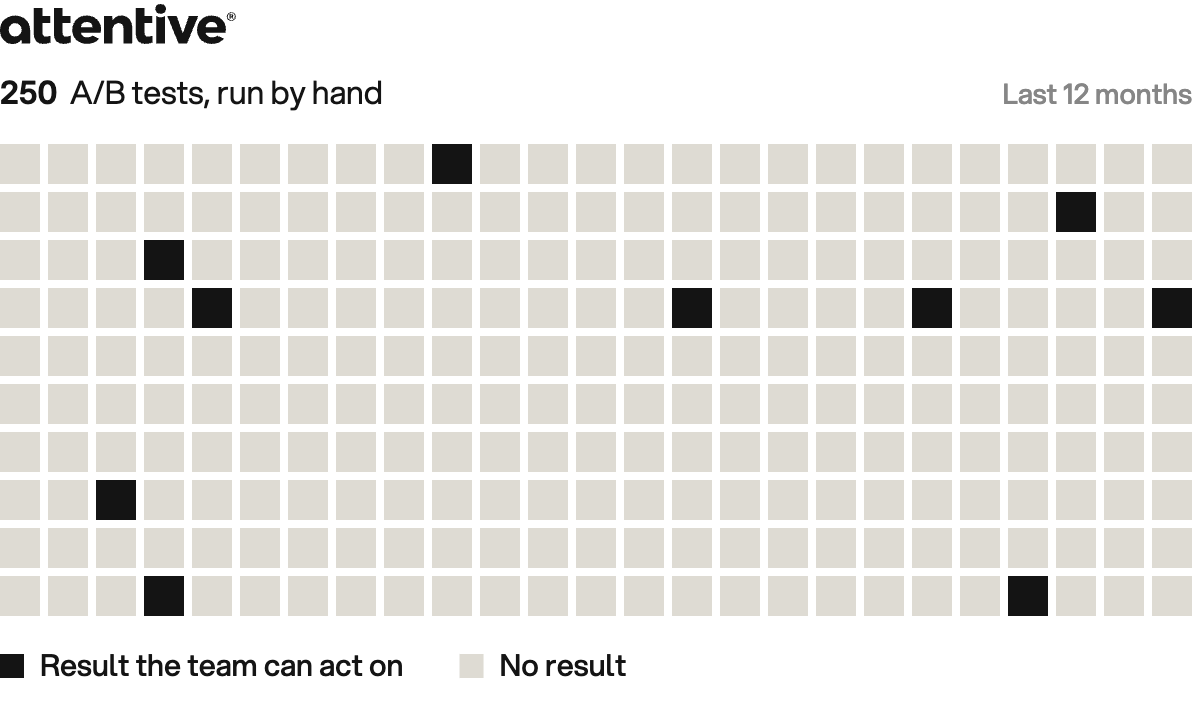
Relvino's agents analyzed 26.7M data points across TOMS's orders and on-site shopper behavior and identified 16% margin recovery on cart abandonment flows, where most discount spend was going to shoppers who were already buying. In place of 250 hand-run A/B tests, discounts are now set by each shopper's conversion probability.

16%
margin recovery identified on cart abandonment flows
26.7M
data points analyzed
0
A/B tests run

TOMS didn't need more messages. It needed to know which ones were working. Relvino delivered that answer without sending a single email or text, by analyzing on-site shopper behavior across the TOMS storefront alongside the brand's order history.
The challenge
Lots of sending, very little learning
TOMS reaches millions of email and SMS subscribers through Attentive, with hundreds of live journeys and more than a hundred million messages a month. On paper, it's a mature program. In practice, it was hard to tell what any of it was doing.
Attentive is built to send, not to decide. It executes the journeys, triggers and discounts the team configures, delivering them to every subscriber who matches a rule at the time the flow specifies. It does not assess who should receive a message, whether a discount is necessary, or when a shopper has received enough. Each of those decisions falls to the team, and the only way to answer them is another A/B test.
And every one of those tests was human run. Someone had to come up with the idea, build both versions, pick the audience, wait for results and then read them.
- 250 A/B tests, all set up and run by hand, most comparing just two versions
Discounts handed to shoppers who were already buying
The cart flow texted new shoppers 20% off just minutes after they added to cart. But Relvino's agents calculated that most shoppers who buy without a code do it within a few hours, on their own.
- 3 of every 4 cart-discount dollars went to past buyers or shoppers about to check out anyway
- Sign-up codes redeemed by existing customers added even more margin given away

Legacy tools run on A/B tests. Relvino runs on intelligence.
Most platforms prove themselves by sending. Relvino started by listening. Relvino's agents went live on the TOMS storefront and tracked what shoppers actually did: what they browsed, what they added to cart and when they came back to buy.
The agents then joined that behavior with TOMS's Shopify orders and its Attentive account, shopper by shopper. None of what they found sits in a single dashboard. Every finding needed orders, on-site behavior and message data connected for the same person, across millions of shoppers. That's impossible for a marketing team to do by hand. It can only be done by agents, and it's exactly what Relvino's agents do every day.

How Relvino deploys discounts that preserve margin
- Discounts only where they change the outcome. Agents calculate each shopper's probability of purchasing with and without a discount, and offer one only when it meaningfully increases that probability.
- Decisions from the full picture. Orders, on-site behavior and messages read together for every shopper.
Relvino's agents replayed every cart abandonment discount against each shopper's probability of buying without it. The margin given away on orders that would have converted at full price added up to a very high 16%.

This data now powers targeting and personalization that lifts conversions
TOMS didn't have a sending problem. It had a visibility problem. Before a single Relvino message went out, the data alone showed where margin was leaking, why the list was shrinking and why testing wasn't producing answers. That's the difference between a platform that sends and agents that understand.

More case studies

.png)




%25202.svg)